
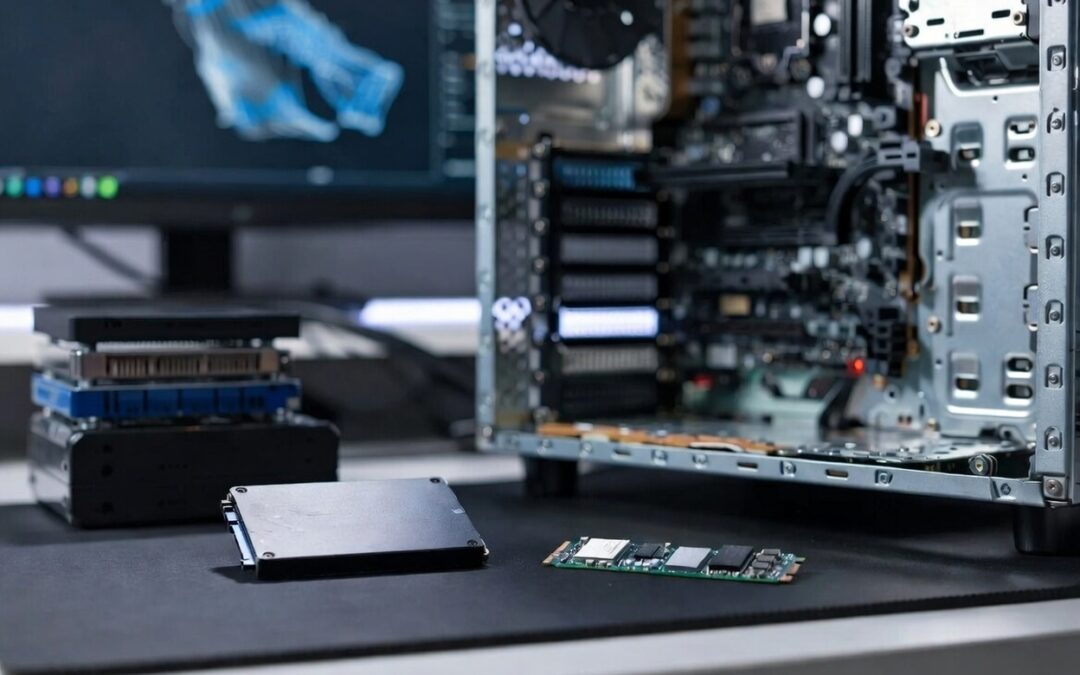
Recent reporting has sparked concern across the storage industry, suggesting that Samsung may be preparing to exit the SATA solid-state drive (SSD) market. While Samsung has now publicly denied those claims, the episode highlights a broader and more important reality: the consumer storage landscape is undergoing a structural shift—one with real implications for businesses, consumers, and long-term data access.
Where the Rumors Came From
The speculation originated with a report from the YouTube channel Moore’s Law Is Dead, which claimed—based on unnamed supply-chain sources—that Samsung intended to end SATA SSD production after fulfilling existing contracts. Given Samsung’s position as one of the world’s largest suppliers of consumer SSDs, the report immediately raised alarms.
The timing did not help. The rumor surfaced shortly after Micron confirmed it was stepping away from certain consumer memory products to focus on AI-driven, high-margin enterprise demand. In an industry already strained by AI-related memory consumption and rising component costs, the idea of another major supplier exiting a mainstream segment felt plausible—and concerning.
Why SATA Still Matters in 2026
From a technical standpoint, SATA SSDs are no longer cutting-edge. With throughput capped at roughly 500–550 MB/s, they cannot compete with NVMe drives that use PCIe interfaces and deliver several gigabytes per second. However, performance alone does not determine relevance.
SATA SSDs remain deeply embedded in real-world systems:
· Older desktops and laptops that lack NVMe support
· Budget PCs and workstations
· External storage enclosures
· Bulk storage applications where capacity and reliability matter more than raw speed
In other words, SATA SSDs continue to be one of the most compatible and cost-effective upgrade paths available. Removing a major supplier from that segment—even gradually—would almost certainly affect pricing, availability, and replacement cycles across the broader storage market.
Samsung’s Official Response
In response to the growing speculation, Samsung issued a direct rebuttal. According to a company spokesperson, “the rumor regarding the phasing out of Samsung SATA or other SSDs is false.” At present, Samsung states it has no plans to discontinue its SATA SSD lineup.
That clarification has eased immediate concerns, but it does not negate the broader market forces at play. Memory pricing remains under pressure, enterprise and AI demand continues to absorb manufacturing capacity, and consumer-focused storage products are increasingly competing for wafer allocation.
The Bigger Picture: Technology Moves On, Data Does Not
Even if SATA SSDs remain available for years to come, the direction of the industry is clear. Interfaces change. Product lines consolidate. Manufacturers prioritize emerging markets with higher margins. For end users, that evolution often happens quietly—until a drive fails, a replacement is unavailable, or compatibility becomes an issue.
From a data-recovery perspective, these transitions matter. As older interfaces fade and newer technologies dominate, recovering data from legacy systems can become more complex, not less. Controllers, firmware behaviors, and NAND architectures evolve rapidly, while the data people depend on often spans decades.
A Practical Takeaway for Businesses and Consumers
The lesson is not to panic about SATA SSDs disappearing tomorrow. It is to recognize that storage technology has a lifecycle—and data outlives hardware. Whether a drive uses SATA, NVMe, or an enterprise interface, long-term access to information depends on understanding those transitions and planning accordingly.
As the storage market continues to rebalance around AI, cloud infrastructure, and high-density enterprise systems, reliability, compatibility, and recoverability will matter just as much as speed benchmarks.
For those relying on existing systems—or managing data that cannot simply be recreated—awareness is the first layer of protection.
In a market where storage technologies evolve faster than the data they hold, preparedness matters. When a drive fails, a system ages out, or a legacy interface becomes harder to support, the difference between recoverable data and permanent loss often comes down to timely, informed action. If your organization—or your personal workflow—depends on data stored across multiple generations of hardware, now is the time to assess risk, understand your exposure, and know where to turn before a failure occurs. Planning ahead is not about reacting to rumors; it is about ensuring that when the unexpected happens, your data still has a path forward.
Start Your Free Diagnostic Today
☎ (704) 536-1717 | Submit a device
See Why Businesses Trust Us
Google Reviews | BBB A+ Profile | Customer Videos
If it’s important to you, it’s important to us.